
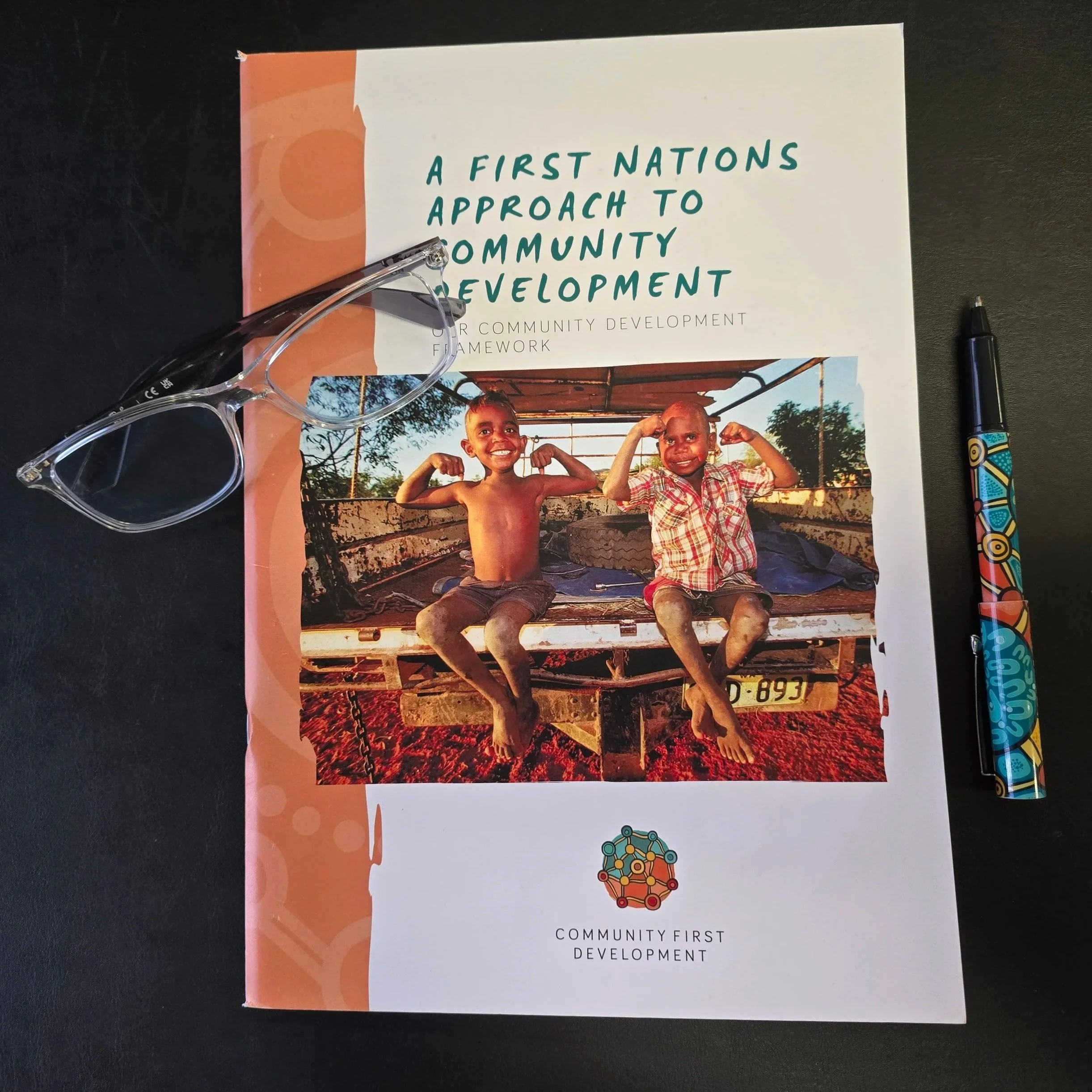
We use our Community Development Framework to guide how we work, but the real work of creating change happens with people and communities.
That distinction matters.
It is easy to think of community development as a process: develop a plan, identify the need, deliver a project, and measure the results. But meaningful change is rarely that simple. It happens when people have a genuine say in what happens, when they can build on their existing strengths and when they have the relationships, resources and support to act on what matters to them.
So what does that look like in practice?
After decades of working alongside First Nations communities, we have learned that there are some important differences between doing something for a community and supporting a community to lead its own change.
These lessons are at the heart of our Community Development Framework, but they are also useful for anyone working with communities, whether you are in government, philanthropy, research, business or the community sector.
Start with the assets that already exist
One of the easiest mistakes in community development is to start with what is missing. A problem is identified. A solution is developed. A program is designed. Then people are invited to participate.
Community-led development starts somewhere else.
It starts by asking what is already there.
Every community has knowledge, skills, relationships, culture, experience, and ideas. And there is so much power in these existing assets. People have often been working on issues and creating solutions long before an organisation or project arrives.
That means some of the most useful questions are simple ones: What is already working? What are community already proud of? What strengths can we build on? What matters most to people here?
Starting with strengths changes the conversation. Instead of seeing a community as having a problem to be solved, we see our communities as having knowledge and capability that can drive the solution.
What you can take away: Start with the strengths, knowledge and resources already in the community. Before co-designing a solution with the community, understand what people already have and build from there.
Communities define the problem and the solution
Sometimes community members are involved in a project without having a meaningful role in shaping its direction.
A consultation might ask for feedback on a solution that has already been designed. A survey might ask people to rank priorities that someone else has chosen. A community meeting might happen after the major decisions have already been made.
That is participation, it is not community leadership.
Community-led development means communities have a meaningful role in deciding what matters, what they want to achieve, and how they want to get there.
This is particularly important when working with First Nations communities. There is no single solution that will work everywhere, because each community has different histories, cultures, strengths, priorities, and aspirations.
The people who live in a community are best placed to understand their own circumstances.
Our role is not to tell communities what change should look like. It is to listen, ask questions, share what we can and support communities to determine their own direction.
What you can take away: Don't start by asking, “What solution can we offer?” Start by asking, “What does the community want to change, and what support do they want to achieve their aspiration?”
Relationships are not separate from the work
Good community development takes time because relationships take time.
Trust is built by listening, showing up, doing what you say you will do and respecting people's knowledge and leadership. It grows when people feel safe to speak honestly, disagree, ask questions, and change their minds.
This can be difficult in a culture where projects are often driven by deadlines, funding agreements, and pressure to show quick results.
But rushing the relationship can undermine the work.
For First Nations communities, working respectfully also means understanding and responding to local culture, leadership, knowledge and ways of making decisions. This takes time, and this is why at Community First Development we work at the speed of trust.
What you can take away: If you want people to have ownership of a project, don't treat relationship-building as the time before the “real work” starts. It is part of the real work.
We bring skills and support, while communities lead
Our team and volunteers bring useful skills and knowledge when working with a community partner: sharing their experience, connecting people, or specialist knowledge.
Those things make a real difference.
But there is a line between supporting community leadership and replacing it.
It can be tempting to take over when we have the expertise or when there is pressure to get something done. We might write the plan, make the decisions, and drive the project because it feels faster.
But faster does not always mean better.
By keeping community leadership at the centre, we can support communities to build on the work and take it forward in ways that reflect their priorities.
Community-led development asks us to take a step back and think about what our support is building along the way.
Are people developing new skills? Are relationships becoming stronger? Is the community gaining access to resources and opportunities? Is decision-making staying with the people it affects?
Sometimes our role is to share expertise. Sometimes it is to connect people with the right resources. Sometimes it is to support turning an idea into a plan. Our role is to support communities to lead from the beginning and throughout the journey.
What you can take away: Good support builds on what is already there and strengthens the skills, knowledge, confidence and ownership communities can carry forward.
Don't mistake the plan for the outcome
Plans are useful. Strategies are useful. Measures are useful.
But they are not the change itself.
Community priorities can change. New opportunities can emerge. Communities can discover new information that expands their thinking. Ultimately, circumstances can shift.
A community might begin with one idea and decide along the way that something else matters more.
That does not mean the project has failed.
It simply means people are learning and responding to what is happening around them.
This is why community development needs room for reflection and adaptation. Rather than asking only whether we delivered what was originally planned, we also need to ask whether the work is responding to what the community wants.
What you can take away: A strong plan should provide direction and stay flexible.
Look beyond the project
One of the biggest lessons in community-led development is that the project is rarely the whole story.
A new program might be delivered. A business might be established. A strategy might be completed. A community space might be created.
But what happens because of that work?
Perhaps people have developed new skills. Perhaps new leaders have emerged. Perhaps relationships have strengthened. Perhaps people have greater confidence to speak up, make decisions, or pursue another opportunity.
These outcomes can be less visible than a completed project, but they can be far more important to long-term community strength.
This changes the question we ask about success.
Instead of only asking: “Did we deliver what we planned to achieve at the outset?”
We can also ask: "What has changed for the people and community, and what can they now do that they could not do before?”
What you can take away: Measure the change that matters to people, not just the activities an organisation completed.
So where does our Community Development Framework fit?
Our Community Development Framework plays an important role.
The framework captures the principles and practices that guide how we work alongside communities. It helps us think about how we understand community, build relationships, connect people and resources, support community-led action, and reflect on what we are learning.
There is no process that can tell you exactly what will work in every community. Every community is different, and what works in one place may not work in another.
The framework gives us guidance and a way to stay grounded while remaining responsive to the people and communities we are working alongside.
The framework guides the journey, but the direction comes from communities identifying their own priorities, aspirations, and opportunities for the future.
What does this mean for anyone working with communities?
Whether you are developing a program, funding a community initiative, conducting research or working for a community organisation, the same questions can be useful:
Who is making decisions? Do the people most affected have genuine influence over the direction of the work?
What are we building on? Are we recognising and acting on the knowledge, strengths, and relationships that already exist?
What are we leaving behind? Will people have greater capability, confidence, connections, or ownership because of the work?
Are we prepared to change direction? If the community's priorities change, how can the project change to meet their greatest need?
These questions can help shift our thinking from doing things for communities, to working alongside communities. Because ultimately, community development is not about finding the perfect framework or designing the perfect project. It is about creating the conditions for people to come together, identify what matters to them and lead the change they want to see.
Our framework helps guide that work.
At the framework's core, is the belief that we as First Nations people have the right to determine our own futures. The framework is not designed to tell communities what to do. Instead, it exists to support communities to lead, make decisions, and pursue the outcomes that matter most to them.